Browse Items (4207 total)
Sort by:
An Abstract of the Rules of the Boston Medical Library

These stern regulations for the ordering of the Library were in place soon after its formation. The complete catalogue indicates that of the 29 titles, nearly one-third were current periodicals, attesting to the Trustees' intention to make the…
Catalogue of Books in the Boston Medical Library (1807)

With nearly 150 titles, this second catalogue of the Library from 1807 attests to its rapid growth and includes a list of over fifty titles on order. The holdings include works on phrenology, botanic medicine, and a number of titles concerning…
Catalogue of Books in the Boston Medical Library, and the Rules and Regulations concerning the Same (1808)

The copy of the 1808 Catalogue belonged to Dr. John Collins Warren, who held the office of Librarian at this time. The emendations probably represent an inventory of the collection, along with printing corrections for a subsequent edition in 1810.
Report from the Trustees on the state of the Library

The 1808 Catalogue includes a report from the Trustees on the state of the Library, providing the clearest statement of their intentions for the collection and its usefulness. As a result of the collection's rapid increase and acquisition of current…
Catalogue of Books in the Boston Medical Library and the Rules and Regulations concerning the Same (1810)

After the printing of the 1810 edition of the Library's Catalogue, this interleaved copy was used to record subsequent acquisitions. The growth of the collection was so rapid, with over 350 new acquisitions, that another edition of the catalogue was…
Catalogue of Books in the Boston Medical Library; and the Rules and Regulations concerning the Same (1816)

In 1819, the Boston Medical Library and the Library of the Massachusetts Medical College were unified and the collection made available to Harvard's medical students. This copy of the 1816 Catalogue belonged to a medical student, probably John Orne…
Catalogue of Boston Medical Library Arranged in Numerical Order

One of the few surviving records of the Boston Medical Library, this manuscript catalogue, unlike the printed versions, divides the collection by size—into folios, quartos, octavos, and duodecimos—with each title receiving a shelf mark…
Catalogue of Books in the Boston Medical Library and the Rules and Regulations concerning the Same (1823)

The last printed version of a Boston Medical Library catalogue appeared in 1823 and described nearly 800 titles. The rules and regulations on circulation and fines differ considerably from the previous edition and probably reflect changes consequent…
Oral History Interview with Grant V. Rodkey, MD, Boston Medical Library Oral History Project

Oral history interview between Joan Ilacqua and Dr. Grant V. Rodkey, taken 12 December 2014 at the Francis A. Countway Library of Medicine, Boston, Massachusetts. Topics include history of the Boston Medical Library, creation of the Countway Library,…
Oral history interview with Paul S. Russell, MD, Boston Medical Library Oral History Project

Oral history interview of Paul S. Russell, MD, conducted by Joan Ilacqua on behalf of the Boston Medical Library. Topics include history of the Boston Medical Library, renovating the Francis A. Countway Library of Medicine, and the Joint Committee of…

A Catalogue of Phrenological Specimens Belonging to the Boston Phrenological Society

Formed after the death of Johann Gaspar Spurzheim, the Boston Phrenological Society assembled a large collection of skulls, masks, and casts of famous and infamous heads to illustrate the various phrenological faculties.
Correspondence to John Collins Warren (1778-1856) regarding the Boston Phrenological Society cabinet

Correspondence were in the back of John Collins Warren, II's, Original Draft of The Collection of the Boston Phrenological Society: A Retrospect. These letters relate to the Boston Phrenological Society in its final days of being an organization.…
Minute book

During the summer of 1842, the Boston Society for Medical Improvement, a scientific organization of which Holmes and many of his friends from his European sojourn were members, began to consider the question of puerperal fever. Following reports of…
"To arms! To arms! : Men of Massachusetts! Your country is in danger! ...
Fill up the regiments then, and let not Massachusetts be behindhand in sending her quota of troops ... "

After his older brother, Henry Pickering Bowditch, enlisted, Charles, then finishing his sophomore year at Harvard College, sought his father's permission to do the same. When his request was refused, Bowditch wrote, "The country must be aroused to…
Composite Portraits

An arrangement of composite portraits by Henry Pickering Bowditch (1840-1911) in the publication from the second International Exhibition of Eugenics in 1921. While the composite photographs on display here as well as others in the collections of the…
Twelve Boston physicians and their composite portrait

Dr. H. P. Bowditch took photographs of himself and eleven colleagues—all members of a physician’s dining club, the Kappa Pi Eta—in 1887 and again in 1892 and then devised a composite portrait of all twelve to isolate the common…
A group of Saxon soldiers and their composite

Bowditch reproduced and described this composite image of Saxon soldiers, as well as a composite image of Wend soldiers, in his article, “Are composite photographs typical pictures?” printed in McClure’s magazine in September 1894.…
A group of Wend soldiers and their composite

Bowditch reproduced and described this composite image of Wend soldiers, as well as a composite image of Saxon soldiers, in his article, “Are composite photographs typical pictures?” printed in McClure’s magazine in September 1894.…
Needs of the Harvard Medical School in the Immediate Future

As a complement to the fund raising campaign for the new campus, Drs. H. P. Bowditch and J. Collins Warren produced this pamphlet to inspire donations to endow professorships, departments, and scholarships at the school.
The past, present and future treatment of homœopathy

H. I. Bowditch was the sole dissenting voice in the vote to expel homeopaths from the Massachusetts Medical Society in 1871. "By the sympathies excited among the laity, by our worse than foolish persecutions, we have built up their sectarian schools…

Autograph letter signed : Ely's Ford, Va., to [Jonathan Ingersoll Bowditch, Boston, Mass.].

Bowditch writes:
I write this to send by a waggon train that is going to Rappahannock Station tomorrow morning. They might just as well send us too if there was any one to take the responsibility of it but the comfort of 100 or so wounded men is…
I write this to send by a waggon train that is going to Rappahannock Station tomorrow morning. They might just as well send us too if there was any one to take the responsibility of it but the comfort of 100 or so wounded men is…

Arthroplasty gouge

Metal hip gouge with convex rectangular tip. There is a round metal label with "Arthroplasty Gouge" handwritten in black ink.
Catalogue of Books in the Boylston Medical Library (1824)

Before the formation of the Boston Medical Library, Harvard's Boylston Medical Library was the principal local collection not in private hands. The collection remained with the University in Cambridge after the Medical School removed to Boston in…


Letters to John C. Warren from Bradford

Two short letters sent in order to organize and prepare Warren's writing for publishing.


Thoughts of other days

First line: In sadness do I now look back. At end of text: Jno. W. Brady.
Oral history interview with Julia McCatty (Collymore) RN, NP

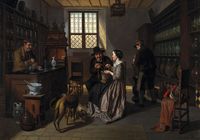
Oral history interview with Julia McCatty Collymore, RN, NP retired, conducted by Brigham and Women's Hospital (BWH) Archivist, Catherine Pate, and Sasha Dubois MSN, RN, NEA-BC at the BWH on May 10, 2023.
Julia McCatty was the first Black person…
Julia McCatty was the first Black person…
Twenty-first Annual Report of the Boston Medical Library

Edwin H. Brigham (1840-1926), the assistant librarian of the second Boston Medical Library, here announces the initial deposit of the medical books of the Athenaeum. Additions deposits, large and small, were made over the next twenty years, with…
Programme of Lectures, and Dates of Meetings, 1902

The Brighton and Hove Phrenological Association sponsored a varied course of lectures including "Phrenology and the Language of Handwriting", "The Brain and Nervous System", "How Phrenology Assists Intellectual, Moral, and Social Progress", and…
Women in Medicine: Guide For Classroom Use

The video series "Women in Medicine" was designed for use in social studies and science classes and in career counseling centers. Nine videotaped profiles introduce students to distinguished women in academic medicine. There are study questions for…
Minutes of Fellows' Meeting

At this meeting of the British Phrenological Society, the phrenological characteristics of different types of teachers were discussed.

Bust of Oliver Wendell Holmes

The BPL original was “ordered by the Mayor of Boston, on authority of the City Council, and was paid for by the city,” according to Annual Report of the Trustees and received at that time (January, 1896).
The Boston Medical Library copy…

Final inspection of the Harvard Unit at Fort Totten, N.Y.

Photograph of the final inspection of the Harvard Unit at Fort Totten, N.Y.
Photograph of the Officers of U.S.A. Base Hospital No. 5 (Harvard Medical School Unit), taken at Fort Totten, N.Y., May 10, 1917.

Taken on the day before departure for Europe, the photograph shows Drs. Harvey Cushing and Roger I. Lee flanking Major Robert U. Patterson, the commanding officer, in the center of the front row.

The complete herbalist, or the people their own physicians by the use of nature's remedies

In addition to publishing this popular botanic medical text, O. Phelps Brown made and marketed proprietary medicines, such as the "Magic Assimilant" (boneset, chamomile blossoms, smartweed, vervain, and whiskey) for fits and indigestion. He also…
Das Buch der Cirurgia

Brunschwig's Book of Surgery was intended to be a manual of general practice for the independent surgeon and is the first printed German text on this subject. The Cirurgia contains information on the treatment of wounds, dislocations, fractures, and…


Two large curved gouges

Two curved metal gouges with thick handles
Portrait of Dr. Johann Gaspar Spurzheim (1776-1832), 1832

The lithography of Johann Gaspar Spurzheim was originally created by Alvan Fisher, but John H. Bufford created copies too. The first lithographic was published in 1832 by William S. Pendleton from his publishing company, Pendleton's Lithography, in…
Letter from Mary I. Bunting

Mary I. Bunting first approached Dr. Bibring to hold a seminar at Radcliffe College in 1965 shortly after her retirement. Each seminar that followed was a great success and the student wait list to enroll also grew.

The Indian's invitation

"Francis J. Burns, the author of the following poem, became almost blind from inflammation. His health being very poor, and having a large family [to] support, he takes this means of trying to make an honest livelihood. Also, he is trying to raise…
Lines to the people

"Francis J. Burns, the author of the following lines, was born February 19, 856. He became nearly blind from inflammation when one year old. He has been a pupil for three years in the N.Y. State Institution for the Blind at Batavia, Genesee County,…
The Indian's invitation

"Francis J. Burns, the author of the following lines, was born at Lyons, N.Y., February 19th, 1856. He became nearly blind from inflammation when one year old. He has been a pupil for three years, in the Institution for the Blind at Batavia, and is…

Insertion of nasopharyngeal airway

Figure 23 from Obstetrical Anesthesia, Its Priciples and Practice by Bert B. Hershenson, MD demonstrates the proper placement of an endotracheal tube.
Photograph of W. T. G. Morton.

Photograph of W. T. G. Morton.
Argument before the Tewksbury Investigation Committee

A state almshouse for paupers at Tewksbury was founded in 1852. In the 1880s, charges of theft and abuse of the inmates–including the sale of bodies of the deceased to Harvard and other medical schools for anatomical dissection–were…
When you are not in the thick of things - Countway Library of Medicine and Newtonville

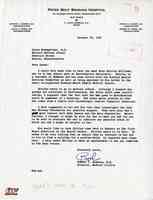
Bystander, Countway Library of Medicine, Harvard Medical School, Newtonville, bombing, shootout [Link to full document at bottom of page]

After-Order by Lieut.-Colonel Hugh Cabot, C.M.G., R.A.M.C., February 1919

At the conclusion of service with the British army in France, the personnel of the Harvard Unit were given this printed communication, extending the thanks of Field Marshall Sir Douglas Haig as well as the commendation of Hugh Cabot:
The months…
The months…


Oral history interview with Malkah Notman (video)

Malkah T. Notman is a Clinical Professor of Psychiatry at Harvard Medical School, Boston, Massachusetts (1988-), a Psychiatrist at Beth Israel Deaconess Medical Center (formerly Beth Israel Hospital), Boston (1973-), and faculty of the Boston…
Card from the Jade Room Students of Cambridge Montessori School

[Link to large image file at bottom of page]
From a collection of cards and objects sent to the Brigham and Women's Hospital by well-wishers after the terrorist bombing of the Boston Marathon on April 15, 2013. The collection represents a…
From a collection of cards and objects sent to the Brigham and Women's Hospital by well-wishers after the terrorist bombing of the Boston Marathon on April 15, 2013. The collection represents a…


Brain of an alcoholic vagrant

Dr. Myrtelle May Canavan, pathologist with the Massachusetts Department of Mental Diseases and a member of the staff of the Boston Psychopathic Hospital, displayed enlarged photographs of fifty brains of criminals and feeble-minded individuals at the…
Cocoanut Grove injuries
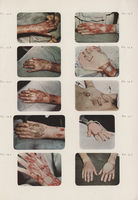
On November 28, 1942 the Cocoanut Grove, a nightclub in Boston's South End caught on fire. There were nearly one thousand people crammed inside and over five hundred of them died. Though Dr. Cannon was drafted earlier in 1942, his induction was…
Burn Study
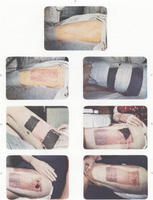
In the early 1940's, Dr. Cannon and Dr. Oliver Cope (1902-1994) became concerned about the effectiveness of tannic acid, then the most common treatment of burns used in Boston. In a study conducted at the Massachusetts General Hospital, Drs. Cannon…
Arm flap rhinoplasty
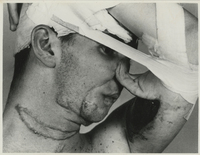
In 1943, Dr. Cannon joined the Medical Corps of the United States Army. He served in the plastic surgery unit at the Valley Forge General Hospital in Pennsylvania, as assistant chief and then chief. This unit performed over 15,000 operations without…
Cannon Moulages

In 1943, Dr. Cannon joined the Medical Corps of the United States Army. He served in the plastic surgery unit at the Valley Forge General Hospital in Pennsylvania, as assistant chief and then chief. This unit performed over 15,000 operations without…
Surgical Instruments of Bradford Cannon
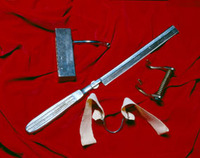
From left to right:
A vacuum device used in skin grafting.
Split Skin Grafting Knife with grooved shaft into which razor sharp blades with a rigid backing are slid.
Wire arch used to minimize tension at the suture line after the cleft lip repair.…
Reports of the Special Investigation Committee on Surgical Shock and Allied Conditions. No. 2. Investigation of the Nature and Treatment of Wound Shock and Allied Conditions.

Soon after his arrival in France with Base Hospital No. 5, Walter B. Cannon was joined to group of surgeons with the B.E.F. at Casualty Clearing Station No. 33 in Béthune, to study the effects of traumatic shock in association with war wounds. He…
Discussion of Johann Gaspar Spurzheim in copy of proposed letter of Nahum Capen to Superintendent Mount Auburn, 1864

Nahum Capen, a practicing phrenologist and the founder of the Boston Phrenological Society, made it his duty to ensure Spurzheim's last wishes were met. In this letter, Capen writes to the Superintendent of Mount Auburn in detail about who had been…

Sarah H. Furber

In 1848, after millworker Sarah H. Furber died following an abortion, physician John McNab (1783-1878) brought her body to Boston and offered to sell it to Holmes as a subject for dissection at the Medical School. The offer was refused, but Holmes…
Oratio in Die Circumcisionis Anno 1484 Habita
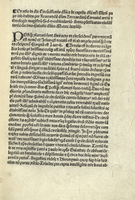
This sermon on Christ’s circumcision, given before Pope Sixtus IV in 1484, explores the symbolic aspects of the ritual and compares it to Christ’s eventual suffering on the cross. Carvajal claims that the process of circumcision and its…
"Breathe" Poster

Poster for "Breathe" an exhibit of objects and images from the history of pulmonary medicine curated by Brigham and Women's Hospital Archivist, Catherine Pate, originally produced for the Brigham Education Institute in 2018. The background image of…
"Painless" Poster

Poster for "Painless" an exhibit of objects and images from the history of anesthesiology curated by Brigham and Women's Hospital Archivist, Catherine Pate, originally produced for the Brigham Education Institute in 2018–2019.
The background image…
The background image…
De medicina

One of the first medical books ever printed, the De medicina is a compilation of knowledge of diet, pharmacy, and surgery from the time of Imperial Rome, circa 30 A.D. In the Renaissance, Celsus' elegant style earned him the title of Cicero…
Oral history interview with Bruce Smith (captioned video)

Oral history interview with Bruce Smith, conducted by the Harvard T.H. Chan School of Public Health Archivist, Heather Mumford, over Zoom on November 16, 2021.
Bruce Smith served initially as the Director of Community Programs (1989 – 1995). In…
Bruce Smith served initially as the Director of Community Programs (1989 – 1995). In…
Henry Jacob Bigelow at age 23

Image of Henry Jacob Bigelow in Paris in 1841.
Oral history and transcript for an interview with Andrew Ulrich, Strong Medicine Oral History Project
Oral history interview between Harvard History of Science graduate student Alyssa Botelho and Andrew Ulrich, Executive Vice Chair of the Department of Emergency Medicine, Boston Medical Center, Boston, Massachusetts. Taken 19 May 2014 at Boston…
Oral history and transcript for an interview with Alasdair Conn, Strong Medicine Oral History Project
Oral history interview between Harvard History of Science Graduate Student Emily Harrison and doctor Alasdair Conn of Massachusetts General Hospital, Boston. Taken 10 February 2014 in Ruth Sleeper Hall at Massachusetts General Hospital, Boston,…